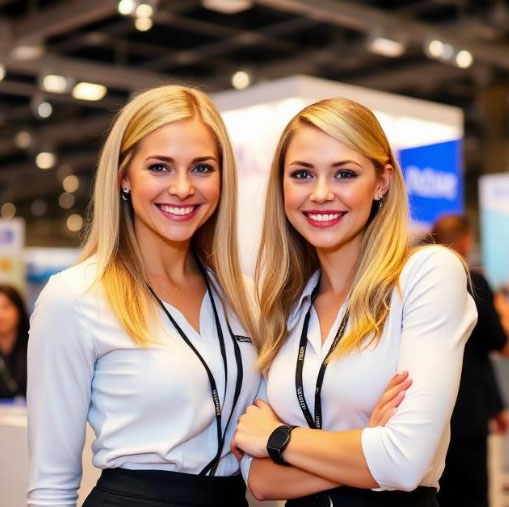
In the vast, buzzing halls of Moscow’s premier venues — Timiryazev Centre and Crocus Expo — international trade comes alive. From Metalloobrabotka and Neftegaz to RosUpack and TransRussia, exhibitors from China, Germany, Turkey, and beyond gather to showcase innovation and seal deals. Yet for all the gleaming machinery and glossy brochures, one element often determines success or failure: communication. This is where Russian exhibition floor interpreters step in—not as mere translators, but as strategic enablers of commerce.
Beyond Words: The Interpreter’s True Role
The Russian exhibition floor interpreter is far more than a walking dictionary. In the high-stakes environment of B2B trade shows, they function as sales facilitators, technical liaisons, and cultural bridges.
A typical day on the floor might involve:
- Assisting a Chinese machinery manufacturer in pitching to Russian buyers
- Translating complex technical specifications during live product demonstrations
- Navigating contract negotiations in real time
- Managing Q&A sessions with visiting engineers or procurement managers
At events like Tube Russia or Mir Stekla (Glass Expo), interpreters must handle everything from casual booth greetings to intense technical discussions. One exhibitor at TransRussia noted: “Our booth interpreter was fluent and highly knowledgeable about our products. She helped us overcome language barriers with Russian clients and facilitated several important deals.”
Mastering Industry-Specific Terminology
Russia’s major exhibitions span virtually every industrial sector, each with its own specialized vocabulary. A skilled interpreter must be prepared for:
| Exhibition | Key Terminology |
|---|---|
| Metalloobrabotka (Metalworking) | CNC machining, seamless pipes, hydrostatic testing, alloy compositions |
| Neftegaz (Oil & Gas) | Corrosion protection, equipment, pipeline integrity, drilling fluids |
| RosUpack (Packaging) | Stretch film tensile strength, corrugated efficiency, shrink wrapping |
| TransRussia (Logistics) | Intermodal freight, customs clearance, supply chain optimization |
Professional interpreters often spend weeks preparing for a single exhibition—studying product catalogs, reviewing technical glossaries, and attending pre-show briefings with their clients. This preparation allows them to handle live demonstrations with confidence and accuracy.
The Cultural Bridge: Beyond Language
In Russian business culture, understanding unspoken rules is just as important as translating words. A seasoned interpreter once noted: “Emotional connection matters when working with foreign guests.” This requires high cultural sensitivity.
Key cultural differences include:
- Russian formality: Titles and surnames are used until invited otherwise
- Relationship-building: Trust is established before business is discussed
- Directness vs. subtlety: Russian communication can be blunt; interpreters soften or clarify as needed
An interpreter familiar with post-Soviet business dynamics—including interactions with delegations from Belarus, Kazakhstan, or Uzbekistan—can navigate historical nuances that affect trust and collaboration.
Shifting Language Demands on the Russian Floor
The linguistic landscape of Russian exhibitions has changed dramatically in recent years.
Chinese–Russian interpreters are now in exceptionally high demand. As Chinese exhibitors dominate sectors like machinery, electronics, and consumer goods, fluency in Mandarin and Russian has become a premium skill. Freelance platforms regularly post urgent requests for “native Russian speakers with fluent Chinese” and industry-specific knowledge (e.g., chemicals or automotive parts).
English–Russian remains the backbone of most international exhibitions. German–Russian and French–Russian interpreters are still sought after for high-end engineering and luxury goods. Meanwhile, Turkish–Russian and Arabic–Russian pairs are growing in importance given shifting trade alliances.
Human vs. Machine: Why Technology Cannot Replace the Floor Interpreter
In an age of AI translation apps, one might ask: Why hire a human?
The answer lies in trust and adaptability. A machine cannot:
- Read the room—detecting hesitation, confusion, or offense
- Adjust tone for formal negotiations vs. casual coffee-break conversations
- Build the rapport necessary to close a deal
- Handle noisy exhibition halls where microphones fail
That said, the future is likely hybrid. Augmented reality (AR) guides may handle basic wayfinding and simple Q&A, while human interpreters focus on nuanced, high-stakes interactions. But the “human touch”—empathy, cultural intuition, and professional judgment—remains irreplaceable.
Becoming a Successful Russian Exhibition Interpreter
For professionals aspiring to excel in this field, several key practices stand out:
- Master industry niches – Specialize in one or two sectors (energy, medical, IT) rather than being a generalist.
- Prepare rigorously – Study client products, company background, and target markets before the event.
- Develop soft skills – Adaptability, poise under pressure, and problem-solving are as vital as linguistic ability.
- Build local knowledge – Understanding Moscow’s venues, logistics, and business customs gives you an edge.
From the metalworking halls of Metalloobrabotka to the glass showcases of Mir Stekla and the logistics corridors of TransRussia, Russian exhibition floor interpreters are the unsung heroes of international trade. They transform language barriers into business opportunities, ensuring that a handshake—and a signed contract—follows every conversation.
For any company planning to exhibit in Russia, investing in a professional, experienced interpreter is not an expense. It is the smartest investment you will make.
