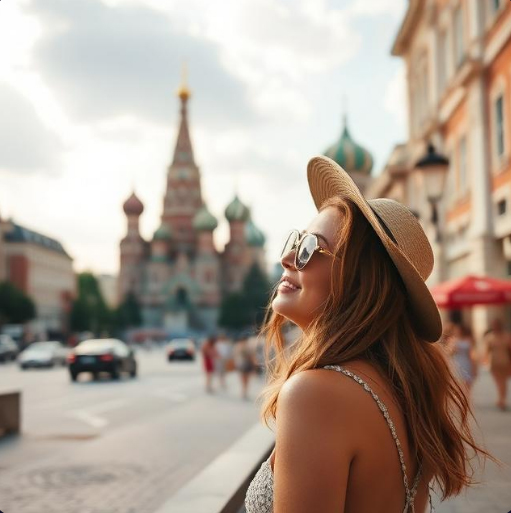
Moscow is a city of astonishing contrasts. Golden-domed cathedrals stand in the shadow of Stalinist skyscrapers. Soviet-era monuments share space with sleek art galleries and futuristic business centers. It is a sprawling, vibrant, sometimes overwhelming metropolis where 800 years of history collide with 21st-century ambition. If you are planning a visit, here is your essential guide to what you absolutely cannot miss.
1. Red Square (Krasnaya Ploshchad)
You cannot come to Moscow and skip Red Square. This is Russia’s main square, the stage for military parades, historical revolutions, and everyday life for half a millennium. Unlike St. Petersburg’s elegant European boulevards, Red Square feels distinctly, unapologetically Russian.
What you will see:
- St. Basil’s Cathedral: With its candy-colored onion domes, this is Moscow’s most recognizable symbol. Built by Ivan the Terrible in 1561, legend says he blinded the architects so they could never create anything so beautiful again. Inside is a labyrinth of tiny chapels and narrow corridors.
- Lenin’s Mausoleum: The embalmed body of the Soviet founder still lies in a dark granite tomb at the square’s center. Entry is free, but lines are long, photography is forbidden, and the atmosphere is solemn.
- GUM Department Store: The grand arcade on the square’s eastern side looks like a 19th-century palace from the outside. Inside, it is a luxurious shopping mall with a glass-roofed atrium, Soviet-era food halls, and a legendary ice cream stand.
- Kazan Cathedral: A vibrant, burnt-orange and gold church on the square’s northeast corner. The original was demolished by Stalin; this is a meticulous 1990s reconstruction.
Tip: Visit Red Square at different times of day. Sunrise (around 4:00 AM in summer) offers almost empty views. At night, when the buildings are lit, it is equally magical.
2. The Moscow Kremlin
The Kremlin is not just a building; it is a fortified city within a city. This triangular complex of palaces, cathedrals, and government buildings sits on the banks of the Moscow River and serves as the official residence of the Russian president. The name “Kremlin” actually means “fortress,” and this one is the heart of Russian political power.
What to see inside:
- Cathedral Square: The spiritual center of historic Russia, surrounded by three magnificent cathedrals. The Dormition Cathedral (Uspensky Sobor) is where czars were crowned. The Cathedral of the Archangel holds the tombs of many early rulers. The Cathedral of the Annunciation features stunning icons by Andrei Rublev.
- Ivan the Great Bell Tower: Climb the 137 steps for the best view over the Kremlin and Red Square.
- The Tsar Cannon and Tsar Bell: The world’s largest cannon (never fired) and the world’s largest bell (cracked before it ever rang). Both are ridiculously oversized and utterly fascinating.
- The Armoury Chamber: This is not about weapons. It is the Kremlin’s treasure museum: Fabergé eggs, coronation robes, imperial carriages, and the diamond-studded regalia of Russian czars. A separate ticket and extra time are required.
Tip: The Armoury Chamber has timed entry and sells out days in advance. Book online. Also, note that the Kremlin closes on Thursdays.
3. The Moscow Metro
Forget what you know about subway systems. The Moscow Metro is an underground palace, a Stalin-era propaganda project designed to show the world the glories of socialism. Each station is a different architectural marvel: marble columns, bronze sculptures, glittering chandeliers, and stunning mosaics.
Must-see stations:
- Mayakovskaya: Art deco elegance with stainless steel columns and mosaic ceilings depicting “24 Hours in the Land of the Soviets.”
- Komsomolskaya: Baroque splendor with yellow ceilings, massive chandeliers, and mosaics of Russian military heroes.
- Novoslobodskaya: Thirty-two vibrant stained-glass panels set into marble walls.
- Ploshchad Revolyutsii: Bronze statues of Soviet archetypes—soldiers, farmers, athletes—at every archway. Rubbing the nose of the border guard’s dog is said to bring luck.
- Kievskaya: Luminous mosaics celebrating Russian-Ukrainian friendship, framed in ornate gold.
Tip: Buy a single “Troika” card for unlimited rides. Avoid rush hour (8:00-9:30 AM and 6:00-8:00 PM) if you want to take photos.
4. Tretyakov Gallery
If you only visit one art museum in Moscow, make it the Tretyakov. While the Hermitage in St. Petersburg focuses on European masters, the Tretyakov is the definitive collection of Russian art, from ancient icons to the avant-garde.
What you cannot miss:
- Andrei Rublev’s Trinity (c. 1425): The most famous Russian icon, a masterpiece of spiritual stillness.
- Ilya Repin’s Ivan the Terrible and His Son Ivan: A horrifyingly vivid painting of the czar clutching his mortally wounded son. (Note: The painting was vandalized in 2018 and may occasionally be off display for restoration.)
- Viktor Vasnetsov’s Bogatyrs: Three epic heroes of Russian folklore, larger than life.
- Kazimir Malevich’s Black Square: The ultimate icon of Suprematism, sometimes called the “zero point” of modern art.
Tip: The Tretyakov is huge. Focus on the 19th and 20th centuries unless you have a deep interest in icons. Allow at least three hours.
5. Christ the Savior Cathedral
The story of this cathedral is the story of 20th-century Russia. The original, built to commemorate Russia’s victory over Napoleon, was demolished in 1931 by Stalin to make way for the Palace of the Soviets—a never-built skyscraper topped with a 100-meter statue of Lenin. The site became an open swimming pool. After the fall of the USSR, the cathedral was painstakingly rebuilt, exactly as it had been, and reconsecrated in 2000.
Why go: The cathedral is stunningly grand. Inside, icons and saints gleam with gold. But the real reason to visit is the observation deck on the cathedral’s upper platform. The view of the Kremlin, the Moscow River, and the city center is spectacular.
Tip: Go late in the afternoon for golden-hour photography from the Patriarchal Bridge that connects the cathedral to the rest of the city.
6. Arbat Street (The Old Arbat)
Moscow’s most famous pedestrian street is equal parts tourist trap and genuine old-world charm. For centuries, Arbat was home to artists, intellectuals, and nobility. Today, it is lined with souvenir shops, portrait painters, street musicians, and outdoor cafes.
Why bother: Despite the crowds, Arbat retains a bohemian spirit. Look for the statue of the poet Alexander Pushkin and his wife Natalya Goncharova (they lived nearby). Find the tribute to Viktor Tsoi, the beloved Soviet rock star, on the wall of a building. Step into the Pushkin Museum apartment. And if nothing else, enjoy an ice cream while watching the city stroll by.
Tip: The fake “Russian” souvenirs on Arbat are overpriced. For authentic crafts, try the Izmailovo Market on weekends.
7. Gorky Park
Once a somewhat rundown Soviet amusement park, Gorky Park has been transformed into Moscow’s most fashionable public space. It is a sprawling green haven along the Moscow River, filled with bike paths, art installations, paddle boats, and chic cafes.
What to do:
- Rent a bike or rollerblades (there are dedicated paths).
- Visit the Garage Museum of Contemporary Art, housed in a stunning Soviet-era concrete pavilion.
- Watch a movie at the open-air summer cinema (with headphones to avoid disturbing the birds).
- In winter, the park becomes a massive ice skating rink.
Tip: Gorky Park is best on a sunny weekend afternoon, when Muscovites come out in full force. Head to the “Muzeon” sculpture garden next door to see a surreal collection of Soviet statues toppled after the fall of communism.
8. VDNKh (Exhibition of Achievements of National Economy)
VDNKh is a time capsule of Soviet optimism. This vast complex of pavilions, fountains, and monumental statues was built in the 1930s and 1950s to showcase the best of Soviet industry, agriculture, and culture. It is huge—bigger than Disneyland Paris—and delightfully bizarre.
Highlights:
- The Pavilion of the Peoples of the USSR: Now home to a massive Lenin statue and various exhibitions.
- The Friendship of Nations Fountain: Sixteen gilded female figures representing the Soviet republics, surrounding a sheaf of wheat.
- The Space Pavilion: Featuring a full-scale replica of the Vostok rocket that carried Yuri Gagarin into space.
- The Moskvarium: A modern aquarium and dolphin theater for families.
Tip: VDNKh is free to enter and enormous. Rent a scooter or take the small on-site tram. Next door is the Ostankino TV Tower—you can go up for a bird’s-eye view of the entire city.
9. Novodevichy Convent and Cemetery
This beautiful 16th-century convent is a UNESCO World Heritage site, but many visitors come for the cemetery next door. Novodevichy Cemetery is the Père Lachaise of Moscow—the final resting place of Russia’s greatest writers, politicians, scientists, and artists.
Who is buried here: Anton Chekhov, Nikolai Gogol, Sergei Prokofiev, Dmitri Shostakovich, Nikita Khrushchev, Boris Yeltsin, Mikhail Bulgakov, and Raisa Gorbachev. The tombstones are often remarkable works of art themselves.
Tip: The convent’s grounds are peaceful and lovely. The cemetery is a quiet, reflective place. Buy a map at the entrance, or you will wander aimlessly.
10. Pushkin State Museum of Fine Arts
Often overshadowed by St. Petersburg’s Hermitage, the Pushkin Museum is Moscow’s premier museum of Western art. Its collection includes ancient Egyptian artifacts, classical sculpture, and a superb collection of European paintings, including works by Rembrandt, Botticelli, and Caravaggio.
The crown jewel: The museum’s collection of Impressionist and Post-Impressionist art—including dozens of works by Monet, Degas, Van Gogh, Gauguin, and Matisse—is among the finest in the world. Much of it was originally collected by Russian merchants Shchukin and Morozov.
Tip: The main building is for ancient and classical art. The Impressionist collection is now housed in a separate building on Volkhonka Street, just a few minutes’ walk away.
11. The Seven Sisters (Stalinist Skyscrapers)
Between 1947 and 1953, Stalin ordered the construction of seven massive skyscrapers in a neo-Gothic, Soviet-baroque style. These “Seven Sisters” dominate Moscow’s skyline and represent the Soviet Union’s postwar ambition.
The most accessible sisters:
- Moscow State University (MGU): The tallest of the seven, perched on Sparrow Hills. Take the metro to Universitet, then walk up to the observation deck in front of the main building for a sweeping view of the city.
- Hotel Ukraina (now Radisson Royal): A luxury hotel with a riverside terrace.
- The Foreign Ministry building on Smolenskaya Square: Often photographed but not open to the public.
- The Kotelnicheskaya Embankment building: A residential building with fantastic views of the Kremlin from its riverfront location.
Tip: For a unique experience, book a table at the 360-degree restaurant on the 30th floor of the Hotel Ukraina (Radisson Royal). Dinner is expensive, but a drink at sunset is worth every ruble.
12. Zaryadye Park
Opened in 2017, Zaryadye is Moscow’s first new large park in 50 years. It occupies the site of the demolished Rossiya Hotel, directly behind Red Square. The park is a stunning feat of landscape architecture, designed to represent Russia’s four major biomes: tundra, steppe, forest, and wetland.
The highlight: The “Floating Bridge,” a 70-meter cantilevered walkway that extends over the Moscow River, offering unparalleled views of the Kremlin. It is free and open 24 hours.
Tip: The park also contains a glass-domed concert hall, an ice cave, and several excellent restaurants. Go at sunset, when the bridge lights up and the Kremlin glows gold.
Practical Tips for Visiting Moscow
- Getting around: The metro is fast, cheap, and beautiful. Download the Yandex.Maps app for navigation and Yandex.Taxi (or Uber Russia) for rideshares.
- Language: English is not widely spoken outside hotels and top restaurants. Learn the Cyrillic alphabet (it takes an afternoon) and a few phrases (Zdravstvuyte – hello, Spasibo – thank you).
- Visa: Most nationalities require a visa for Russia. The electronic visa system (as of 2024-2025) may cover certain travelers, but check current requirements well in advance.
- Money: Russia has largely moved away from Visa and Mastercard (due to sanctions). Bring cash in US dollars or euros and exchange locally, or use the Russian Mir card system if you have access.
- Phone: Buy a local SIM card from operators like MTS or Beeline at the airport or city shops.
- When to go: May-June and September are ideal (mild weather, fewer crowds). July-August is warm but crowded. December-February is very cold (-10°C to -20°C) but beautiful, with Christmas markets.
Moscow demands time and patience. It is not a neat, tidy European capital. It is loud, sprawling, and sometimes frustrating. But it is also endlessly fascinating. Stand in Red Square at dusk, and you feel the weight of centuries. Ride the metro, and you travel through a lost ideology’s dreams of the future. Watch Muscovites in Gorky Park on a summer evening, and you see a city that has survived everything history threw at it and emerged more vibrant than ever.
Come prepared to walk, to stare upward at gilded domes and Stalinist spires, and to leave with a new understanding of Russia’s magnificent, maddening heart.