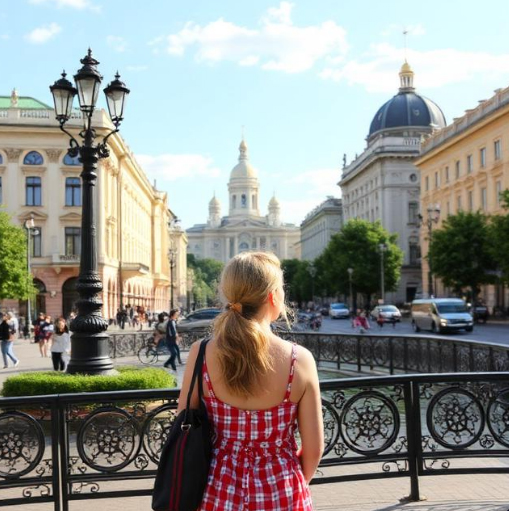
St. Petersburg is not a city you simply visit; it is a city you experience. Built on a swamp by the will of Peter the Great, it became an imperial capital of breathtaking ambition. With its majestic palaces, world-class museums, romantic canals, and a complex history of czars and revolutions, St. Petersburg offers more sights than you could cover in a single trip. Here is your guide to the absolute must-see attractions.
1. The State Hermitage Museum (Winter Palace)
No list begins anywhere else. Housed in the magnificent baroque Winter Palace, the former home of Russian emperors, the Hermitage is one of the world’s greatest art museums. Its collection of over three million items is so vast that if you spent just one minute looking at each exhibit, it would take you nearly six years to see everything.
What you cannot miss: The magnificent Jordan Staircase, the Peacock Clock (a working 18th-century automaton), the Malachite Room, and masterpieces by Leonardo da Vinci, Rembrandt, Michelangelo, and Van Gogh.
Tip: Book tickets online in advance and arrive early. The museum is enormous—plan at least three to four hours, or accept that you will only see a fraction.
2. The Church of the Savior on Spilled Blood (Spas na Krovi)
With its vibrant, candy-colored onion domes and intricate mosaic exterior, this church looks like it belongs in a fairy tale. It was built on the spot where Emperor Alexander II was assassinated in 1881. Inside, the walls are covered with nearly 7,000 square meters of mosaics—one of the largest collections in Europe.
What makes it special: Unlike many European cathedrals, the interior is not painted but entirely mosaic. The canopy marking the exact location of the assassination remains in place.
Tip: The church is stunning from every angle. For the classic postcard photo, cross the Griboyedov Canal via the nearby pedestrian bridge.
3. Peterhof Palace and Gardens (The Russian Versailles)
Located about an hour outside the city center by hydrofoil, Peterhof was Peter the Great’s extravagant answer to Versailles. But while Versailles has gardens, Peterhof has fountains—more than 150 of them. And here is the engineering marvel: none of them use pumps. They operate entirely by gravity from natural springs.
The highlight: The Grand Cascade, which descends from the palace to the Baltic Sea. At its center stands a golden statue of Samson tearing open the jaws of a lion, sending a jet of water 20 meters into the air.
Tip: Take a hydrofoil from the pier near the Hermitage for the most scenic approach. The fountains operate only from May to October, so summer is essential.
4. St. Isaac’s Cathedral
The largest Russian Orthodox cathedral in the city, St. Isaac’s is an architectural heavyweight. Its gilded dome dominates the skyline, covered with over 100 kilograms of gold. Inside, you will find malachite and lazurite columns, massive mosaic icons, and a sense of scale that is genuinely awe-inspiring.
The best view in the city: Skip the interior if you are short on time, but do not skip the climb up the 262 steps to the colonnade surrounding the dome. The 360-degree panorama of St. Petersburg is unmatched.
Tip: Go just before sunset. The golden light on the dome from above is a photographer’s dream.
5. Nevsky Prospekt
St. Petersburg’s main artery is more than just a street; it is the city’s beating heart. Stretching nearly four kilometers from the Admiralty to the Alexander Nevsky Monastery, walking Nevsky is like walking through a living museum.
Sights along the way:
- Kazan Cathedral: An enormous Russian Orthodox cathedral with a striking colonnade modeled after St. Peter’s in Rome.
- Dom Knigi (House of Books): A stunning art nouveau bookstore on the corner of Nevsky and the Griboyedov Canal. The cafe upstairs has great views.
- Yeliseyevsky Gastronome: A lavishly decorated luxury grocery store that is worth stepping into just for the interior.
- Anichkov Bridge: Famous for its four dramatic horse-taming statues.
Tip: Nevsky is pedestrian-friendly and most beautiful in the early evening during the White Nights. Take your time and wander.
6. The Peter and Paul Fortress
This is where St. Petersburg began. Peter the Great founded the city here in 1703, on a small island in the Neva River. The fortress never saw military action but became a notorious political prison, housing everyone from Dostoevsky to Lenin’s older brother.
Inside the fortress:
- Peter and Paul Cathedral: The final resting place of nearly all Russian emperors from Peter the Great to Nicholas II and his family. The golden spire is a city landmark.
- The Trubetskoy Bastion Prison: A chilling look at czarist prison conditions.
- The beach: On summer weekends, locals sunbathe on the fortress’s western beach with a perfect view of the Hermitage across the water.
Tip: At noon every day, a cannon fires from the fortress walls. It has been doing so since 1873.
7. The Yusupov Palace
Often overlooked by tourists rushing to the Hermitage, the Yusupov Palace is a gem. This was the home of the immensely wealthy Yusupov family, and it is famous for one dark night in 1916 when a group of nobles, led by Prince Felix Yusupov, assassinated the Siberian mystic Grigori Rasputin.
Why go: The palace feels lived-in and intimate, unlike the state rooms of the Winter Palace. The Moorish Drawing Room, the private theater, and the dimly lit basement where Rasputin was killed (complete with wax figures recreating the scene) tell a gripping story.
Tip: The audio guide includes dramatic reenactments of the murder. It is well worth the extra time.
8. The Fabergé Museum
Opened in 2013, this museum houses the world’s largest collection of works by the legendary jeweler Carl Fabergé. Yes, you will see the famous Imperial Easter Eggs—nine of them, to be exact.
The showstopper: The 1900 Trans-Siberian Railway egg, complete with a miniature clockwork train of platinum and gold. Also the 1913 Winter Egg, carved of rock crystal and platinum with thousands of diamonds.
Tip: The museum is in the beautifully restored Shuvalov Palace on the Fontanka River. It is a smaller, more manageable visit than the Hermitage.
9. The Summer Garden (Letny Sad)
St. Petersburg’s oldest park is a quiet refuge from the city’s bustle. Designed by Peter the Great in the early 1700s, it follows a formal French layout with straight paths, marble statues imported from Italy, and carefully manicured hedges.
Why visit: The Summer Palace, Peter’s modest two-story home, sits tucked away in the corner. But the real pleasure is simply walking among the fountains and fabled statues on a warm summer afternoon.
Tip: Entrance is free, but the park closes early (around 9:00 PM even in summer). Go in late afternoon for the best light.
10. A Canal Cruise (The Northern Venice)
With over 300 bridges and 100 canals, St. Petersburg truly deserves its nickname. To understand why, you need to get on the water. A canal cruise takes you under low bridges, past colorful facades, and into hidden courtyards inaccessible by land.
Best routes: The trip along the Griboyedov Canal passes directly behind the Church of the Savior on Spilled Blood. The Moika and Fontanka canals offer views of palaces like the Yusupov Palace. For the iconic experience, book a cruise during the White Nights to see the opening bridges.
Tip: Avoid the loud, crowded “party boats.” Smaller, quieter boats with pre-recorded audio guides are usually more pleasant.
11. The General Staff Building
Right across from the Winter Palace, the General Staff Building is part of the Hermitage complex but deserves its own mention. While the Winter Palace focuses on old masters and imperial interiors, the General Staff Building houses the Hermitage’s collection of Impressionist and Post-Impressionist art.
What you will see: Matisse’s Dance, Picasso’s early works, and a stunning collection of Van Gogh, Gauguin, and Monet. The building itself, with its triumphal arch and sweeping curve, is an architectural masterpiece.
Tip: Many tourists skip this building, so it is far less crowded than the main Winter Palace.
12. A Day Trip: Pushkin (Tsarskoye Selo)
If you have an extra day, take the 30-minute train ride to the town of Pushkin, home to the Catherine Palace. The palace itself is a feast of blue, white, and gold, but everyone comes for one room: the Amber Room.
The Amber Room: Panels of amber, gold leaf, and mirrors create a warm, glowing space that was once called the “Eighth Wonder of the World.” The original was looted by Nazis in 1941 and disappeared. This is a painstakingly reconstructed version, but it is breathtaking.
Tip: The palace is extremely popular. Book your timed entry ticket online weeks in advance.
Practical Advice for Your Trip
- Getting around: The St. Petersburg metro is deep, beautiful, and efficient. Some stations, like Avtovo and Mayakovskaya, are tourist attractions in their own right.
- Museum closures: Most museums close one day a week (usually Monday for the Hermitage, Wednesday for the Russian Museum). Check before you go.
- Skip the lines: For the Hermitage, Peterhof, and Catherine Palace, buy tickets online and consider paying extra for “skip the line” options in summer.
- Weather: Summer is glorious but crowded. May and September offer fewer tourists and mild weather, though the White Nights are only in June-July.
- Language: English is common in major museums and hotels but not on street signs or public transport. Have your destinations written in Cyrillic.
St. Petersburg is not a city you conquer in a weekend. It is a city that asks you to slow down, to wander, to look up at the gilded domes and down at the canal reflections. You will leave with sore feet, a full camera roll, and the certain knowledge that you have seen one of the most beautiful cities on earth.
Whether you come for the art, the history, the architecture, or the magical White Nights, St. Petersburg delivers. Pack comfortable shoes, bring your curiosity, and prepare to be amazed.