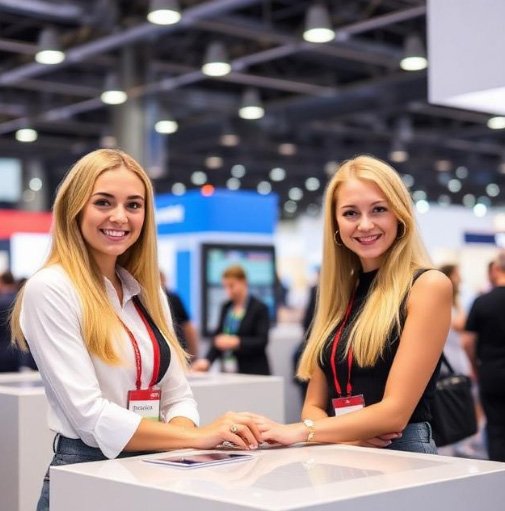
MOSCOW – The air inside Crocus Expo’s Pavilion 1 is thick with the scent of fresh print, dust from sample catalogs, and the low hum of hundreds of conversations happening simultaneously. At MosBuild 2026, Russia’s largest international building and interiors exhibition, over 1,300 exhibitors from 50 countries and nearly 70,000 professional buyers have gathered. Amid the labyrinth of stands displaying ceramic tiles, power tools, and roofing systems, a different kind of specialist is at work. This person carries no sample case and wears no company uniform. She carries a notepad, a headset, and the weight of multimillion-ruble deals on her shoulders. She is the technical interpreter, and in the high-stakes world of Russian construction, she is as essential as a foundation.
For foreign manufacturers—from Chinese lighting companies to Turkish facade specialists and German toolmakers—the path to the Russian market runs directly through these interpreters. But not just any interpreter. The building industry requires a rare hybrid: a linguist who can read a structural drawing, a diplomat who understands GOST, and a quick-thinking professional who can translate cubic meters of trust in real time.
The Generalist vs. The Specialist
The old stereotype of an exhibition interpreter—a bilingual student handing out pens and saying “hello” in two languages—has become a costly liability in Moscow’s building trade shows.
“A general interpreter might be fine for a food expo,” says Sergei, a senior coordinator for a large Moscow trade fair. “But at a construction fair? The buyer will ask about ‘moment-resisting connections’ or ‘erection sequencing.’ If the interpreter doesn’t know those terms—and I mean know them cold—the buyer walks away. You lose the deal before you even quoted a price.”
The technical vocabulary of construction is unforgiving. Terms like “composite decking,” “bolted splices,” “seismic-resistant steel frames,” and “fire protection solutions” have precise Russian equivalents that a non-specialist will miss. And in an industry where a misunderstood specification can lead to a collapsed wall or a failed inspection, Russian buyers have zero tolerance for ambiguity.
The GOST Gatekeeper
Perhaps the single greatest challenge for any foreign exhibitor is the dense forest of Russian technical regulations. GOST standards, SNiP (Construction Norms and Regulations), EAC (Eurasian Conformity) marks, fire safety permits, and sanitary approvals form a daunting maze.
A Russian buyer’s first question is rarely about price. It is always: Is it certified for Russia?
“I once interpreted for a Turkish laminate flooring company,” recalls Olga, a technical interpreter who holds a degree in civil engineering. “The buyer picked up a sample, scratched it with his key, and then asked for the EAC certificate number. The Turkish manager had no idea what he was talking about. I stepped in and explained that the documentation was in the final stage of submission. I saved the conversation. But if I hadn’t known what an EAC certificate was—if I had just shrugged—the buyer would have been gone in ten seconds.”
This is the interpreter as gatekeeper. She doesn’t just translate words; she translates the regulatory landscape, warning foreign exhibitors which claims to avoid and which documents to display prominently.
The Engineer Who Interprets
The most sought-after interpreters in Moscow are not pure linguists. They are engineers who happen to speak two languages.
Daria, 31, graduated from Moscow State University of Civil Engineering before becoming an interpreter. She has assisted Chinese lighting manufacturers and German power tool brands at MosBuild.
“Last year, a buyer asked me not just about the lumens of our lamp, but about how its driver would handle voltage fluctuations common in Russian regional power grids,” she says. “The Chinese engineer next to me didn’t know. I did. Because I’ve studied electrical systems. The buyer’s entire attitude changed when he realized I understood the technical problem, not just the words.”
Interpreters like Daria command daily rates three to four times higher than general linguists. But for serious exhibitors, the investment is non-negotiable. They are hired weeks or even months before the show, given technical manuals, product specifications, and project references to study. A proper preparation includes a “chief engineer–interpreter briefing session,” where the technical team walks the interpreter through every product feature, every potential customer objection, and every competitive advantage.
Beyond Translation: Cultural and Commercial Mediation
The interpreter’s role extends far beyond converting Russian to English or Chinese. In the Russian construction industry, relationships matter as much as specifications.
“Russian buyers are famously skeptical of foreign salespeople,” says a Moscow-based exhibition services provider. “They want to know who you are, where you’ve worked before, and whether you understand the Russian climate. An interpreter who can convey not just the words but the tone—the confidence, the respect, the technical certainty—is worth their weight in rubles.”
This cultural mediation is particularly delicate in the current geopolitical climate. Since 2022, the Russian construction market has undergone a seismic shift. With the departure of many Western brands, the government’s “import substitution” policy has accelerated, and Russian manufacturers have stepped up. Foreign exhibitors—now predominantly from China, Turkey, India, and Belarus—must navigate a landscape of rising patriotic sentiment.
“Two years ago, a buyer might have asked, ‘Is this German?’” Olga explains. “Now they ask, ‘Is this available immediately? Do you have a warehouse in Moscow? Can you deliver to Yekaterinburg in winter?’ Speed and reliability have become as important as quality. The interpreter has to understand this shift and help the foreign exhibitor position their product accordingly.”
The Logistics Consultant
In the 2026 edition of MosBuild, the interpreter’s role has expanded yet again. As supply chains remain disrupted and shipping routes shift, buyers are obsessed with logistics.
“I now spend as much time interpreting questions about delivery times and customs clearance as about product specifications,” says a veteran interpreter who has worked in the building industry for eight years. “A buyer from Novosibirsk doesn’t just want to know if our insulation works in minus 30 degrees. He wants to know how many pallets can fit on a truck, how long the journey takes, and whether we have a local distributor. If I can’t interpret those logistics answers accurately, the deal dies.”
The modern building exhibition interpreter is, in essence, a supply chain consultant, a technical expert, a cultural diplomat, and a linguist—all rolled into one.
Different Requirements for Different Languages
The demand for interpreters varies significantly by language pair. English–Russian interpreters remain the most common, as many international brands use English as their internal language. However, with the surge of Chinese exhibitors at MosBuild—China is now one of the largest foreign contingents—the demand for Chinese–Russian interpreters has exploded.
“For Chinese companies, the challenge is even greater,” explains a Russian interpretation agency manager. “Most Chinese exhibitors do not speak English fluently, so English–Russian interpretation is not enough. They need direct Chinese–Russian interpreters. And those interpreters must not only speak the languages but understand the very different business cultures—the Chinese emphasis on relationship-building (guanxi), the Russian desire for direct, technical answers.”
The Human Bridge
At the end of four grueling days, when the last visitors have left with their heavy bags of samples and the exhibition lights dim, the interpreters pack up their headsets and notepads. They are often the last to leave, having stayed to help foreign exhibitors debrief, translate follow-up emails, and organize the leads generated during the show.
“People think we just stand there and talk,” says one interpreter, rubbing her sore feet. “But we are constantly thinking—about terminology, about cultural nuance, about the buyer’s unspoken concerns. Every word matters. A mistranslated number can collapse a negotiation. A misunderstood technical specification can lose a contract worth millions.”
In the tough, pragmatic, high-stakes world of Moscow’s building industry trade shows, the Russian exhibition interpreter is the unsung structural engineer of international commerce. She does not lay bricks or pour concrete. But she builds something just as essential: the trust that allows a Turkish facade to stand on a Russian apartment block, a Chinese tile to warm a Yekaterinburg bathroom, and a German tool to cut steel in a Siberian factory. She is the silent, invisible, indispensable bridge between global ambition and Russian reality.
As MosBuild prepares for its 2027 edition, the message for foreign exhibitors is clear: Bring your best product. But also bring a great interpreter. Because in Moscow’s construction market, you don’t just need to be seen. You need to be understood.