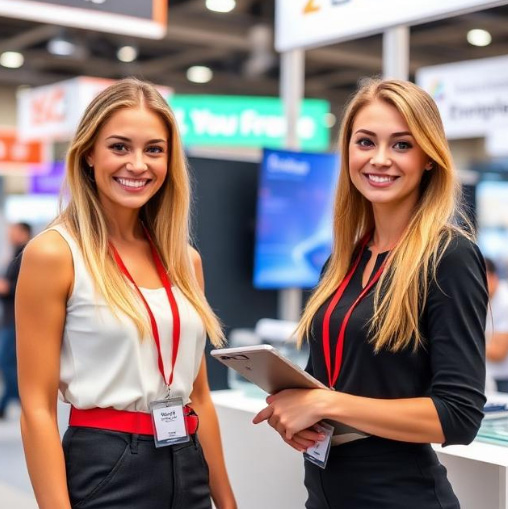
MOSCOW – The air inside Crocus Expo’s Hall 14 is a carefully calibrated perfume of expensive french fragrance, nail monomer, and the faint sweetness of skincare samples. It is the opening day of InterCHARM, the largest beauty trade fair in Russia, Eastern Europe, and Central Asia. Over 1,600 exhibitors and nearly 100,000 professional visitors have gathered under one roof. Amid the glittering stands, the glowing LED mirrors, and the constant hum of product demonstrations, a quiet professional is at work. She carries no makeup bag and no sample tray. She carries a headset, a notepad, and the weight of million-ruble distribution deals. She is the exhibition interpreter, and in the notoriously skeptical, regulation-heavy, and trend-driven Russian beauty market, she is as essential as the formula inside the bottle.
For foreign manufacturers—whether a Korean skincare innovator, a Turkish hair color specialist, or a European luxury perfumer—the path to the Russian market runs directly through these interpreters. But not just any interpreter. The beauty industry requires a rare hybrid: a linguist who understands INCI (International Nomenclature of Cosmetic Ingredients) lists, a diplomat who navigates Russia’s complex certification system, and a cultural translator who knows what a Russian woman actually wants.
The High Price of a Mistranslated Ingredient
The stereotype of an exhibition interpreter as a bilingual student handing out samples and smiling has become a costly liability at Moscow’s beauty trade shows.
“A general interpreter might work for a consumer goods fair,” says Sergei, a senior coordinator for a large Moscow exhibition venue. “But at InterCHARM? A buyer will pick up a cream, turn it over, and ask about the concentration of niacinamide. They will ask about the difference between a chemical and physical sunscreen. They will ask whether the preservative system is compliant with TR CU 009/2011 (the Customs Union regulation on perfumery and cosmetic products). If the interpreter hesitates or gets a term wrong, the buyer walks. You lose credibility in seconds.”
The technical vocabulary of cosmetics is extensive and precise. Terms like “emollients,” “humectants,” “occlusives,” “surfactants,” “chelating agents,” “peptides,” “retinoids,” and “fermented extracts” have exact Russian equivalents. A non-specialist interpreter will stumble. And in an industry where a misunderstood ingredient can trigger a regulatory rejection or a consumer complaint, Russian buyers have zero tolerance for ambiguity.
The Certification Gatekeeper
Perhaps the single greatest challenge for any foreign beauty exhibitor is Russia’s intricate system of cosmetic regulations. EAC (Eurasian Conformity) certificates, state registration certificates, declaration of conformity, and GOST R standards form a dense, intimidating web.
A Russian buyer’s first question is rarely about price or packaging. It is almost always: Is it registered for sale in Russia?
“I once interpreted for a European organic skincare brand,” recalls Olga, a technical interpreter with a degree in chemistry who has worked InterCHARM for six years. “A Russian distributor picked up a serum, read the ingredient list, and immediately asked for the state registration certificate number. The European manager had no idea what she was talking about. He started explaining the product’s certification, which means nothing here. I had to step in and explain that the documentation was in progress. The distributor gave us two weeks. If I hadn’t understood the regulatory landscape, that buyer would have walked away in thirty seconds.”
This is the interpreter as regulatory gatekeeper. She doesn’t just translate words; she translates the entire legal landscape. She warns foreign exhibitors which claims to avoid (e.g., “medicinal” or “healing,” which triggers pharmaceutical regulations) and which documents to display prominently. She knows that a “hypoallergenic” claim requires specific testing documentation, and that “natural” has a legally defined meaning under Russian law.
The Cosmetic Chemist Who Interprets
The most sought-after interpreters at Moscow’s beauty trade shows are not pure linguists. They are chemists, biotechnologists, or pharmacists who happen to speak two or three languages.
Daria, 31, graduated from the Moscow State University of Fine Chemical Technology before becoming an interpreter. She has assisted Korean, Chinese, and Turkish beauty brands at InterCHARM.
“Last year, a buyer picked up our ampoule and asked about the molecular weight of our hyaluronic acid,” Daria says. “Was it low, medium, or high? What was the penetration depth? The Korean marketing manager next to me didn’t know the exact number. I did. Because I’ve studied cosmetic chemistry. The buyer’s entire attitude changed. She started taking notes. That was not translation. That was technical validation.”
Interpreters like Daria command daily rates three to four times higher than general linguists. But for serious exhibitors—especially those from Korea, China, and Turkey, where the beauty industries are highly advanced but Russian language skills are rare—the investment is non-negotiable. They are hired weeks before the show and given technical manuals, ingredient specifications, and regulatory documents to study. Some exhibitors schedule “technical briefings” where their own cosmetic chemists walk the interpreter through every product feature, every potential buyer question, and every competitive advantage.
The Cultural Translator
The interpreter’s role extends far beyond converting Russian to Korean, Chinese, English, or Turkish. In the Russian beauty industry, understanding the consumer is everything.
“Russian women have different skin concerns than Korean or European women,” explains a Moscow-based beauty industry consultant. “They are obsessed with anti-aging, with sun protection (though they don’t always use it consistently), and with products that work in a harsh climate. They are also famously skeptical of marketing hype. An interpreter who can convey not just the words but the credibility—the scientific backing, the clinical results, the respect for Russian skin—is invaluable.”
This cultural mediation is particularly delicate in the current market. Since 2022, the Russian beauty industry has undergone a dramatic transformation. The departure of many Western luxury brands created a vacuum that Korean, Chinese, Turkish, and domestic Russian brands are racing to fill. Russian consumers have become more educated about ingredients and more open to Asian skincare philosophies, but they remain fiercely loyal to certain local preferences.
“Two years ago, a Russian buyer might have asked, ‘Is this French?’” Olga explains. “Today, they ask, ‘Is this available immediately? Do you have a warehouse in Moscow? What is the shelf life in Russian climate conditions?’ The interpreter has to understand this shift and help the foreign exhibitor position their product accordingly—emphasizing speed, reliability, and climate adaptability, not just origin.”
The Claims Substantiation Expert
Perhaps the most dangerous moment for a foreign beauty exhibitor is when a Russian buyer asks for “clinical proof.” Russian regulations on cosmetic claims are strict. A brand cannot say “reduces wrinkles by 50%” without a clinical study conducted according to Russian standards.
“I once interpreted for a Chinese mask brand,” recalls Anna, an interpreter specializing in color cosmetics. “The buyer asked for the clinical trial data. The Chinese manager pointed to a Chinese study. I had to explain—carefully, diplomatically—that Russian buyers generally want to see either Russian clinical trials or internationally recognized studies (like from Korea or Germany). The manager was upset. But I saved him from making a false claim that could have gotten his product in trouble with Rospotrebnadzor.”
The interpreter, in this role, becomes a claims substantiation advisor. She knows what can be said and what cannot. She knows that “whitening” (a common term in Asian cosmetics) has been restricted in Russia due to regulatory changes, and that “brightening” is the safer alternative. She knows that a sunscreen’s SPF claim must be verified by Russian testing. She protects her foreign client from costly regulatory violations.
Different Product Categories, Different Terminology
The beauty industry is not monolithic. Different product categories require specialized terminology—and specialized interpreters.
An interpreter working for a skincare brand must understand emulsions, humectants, and the difference between AHAs and BHAs. An interpreter working for a hair color brand must understand oxidative dyes, ammonia-free formulas, and the specific requirements for professional versus retail products. An interpreter working for a nail care brand must understand monomer-to-polymer ratios and the differences between gel, acrylic, and dip systems. An interpreter for a fragrance house must understand top notes, heart notes, base notes, and the IFRA (International Fragrance Association) restrictions that apply in Russia.
“A skincare buyer asks about pH and preservatives,” says a seasoned interpreter who has worked both skincare and fragrance stands. “A hair color buyer asks about lift and gray coverage. A perfume buyer asks about longevity and sillage. If you mix them up, you look unprofessional. You have to know your category cold.”
The Parallel Evolution of Russian Beauty
The Russian beauty market has grown increasingly sophisticated. Ten years ago, a pretty face and a tray of samples were enough. Today, the Russian consumer—and the Russian professional buyer—is hyper-educated.
“Consumers now watch Russian-speaking dermatologists on YouTube,” explains a beauty industry analyst. “They know what peptides do. They know the difference between L-ascorbic acid and its derivatives. They come to the trade show with specific questions. The foreign exhibitor might not speak Russian. The Russian buyer might not speak English or Chinese. The interpreter is the only person in that conversation who understands both the science and the language.”
This means that the modern beauty exhibition interpreter must be constantly learning. New ingredients emerge. New regulations are passed. New consumer trends appear. The best interpreters subscribe to Russian beauty industry journals, attend webinars on cosmetic chemistry, and maintain relationships with regulatory consultants.
The High-Stakes Demonstration
Perhaps the most intense moment for any beauty interpreter is the live demonstration. A cosmetic chemist or brand representative applies a product to a buyer’s hand or face. The buyer asks questions. The demonstration must be flawless.
In those seconds, the interpreter’s performance is critical. She must translate not only the manufacturer’s description but the subtle cues—the hesitation, the confidence, the unspoken skepticism. A mistranslated claim (“this will instantly lift your skin” vs. “this will create the appearance of lifted skin”) can trigger an angry response. A misinterpreted question (“does this contain alcohol?” meaning “will it dry my skin?” vs. “is it compliant with Russian regulations?”) can lead to confusion.
“I once interpreted for a luxury Russian brand—ironically, I was interpreting for a Russian brand selling to international buyers,” recalls one interpreter. “The Russian CEO made a joke about how his cream was ‘better than La Mer.’ The Chinese buyer didn’t understand the cultural reference. I had to quickly explain that it was a humorous comparison, not a literal claim. That small intervention saved the conversation.”
The Human Bridge
At the end of three intense days, when the last samples are packed and the last visitors have left, the interpreters pack up their headsets and notepads. They are often the last to leave, having stayed to translate follow-up emails and help exhibitors organize the leads generated during the show.
“People think we just stand there and translate words,” says one interpreter, rubbing her feet. “But we are constantly thinking—about ingredients, about regulations, about the buyer’s unspoken concerns. A mistranslated percentage can collapse a negotiation. A misunderstood claim can trigger a regulatory complaint. We carry the entire conversation on our shoulders.”
In the glittering, high-stakes, and increasingly scientific world of Moscow’s beauty trade shows, the Russian exhibition interpreter is the unsung chemist of international commerce. She does not formulate serums, mix pigments, or compound fragrances. But she builds something just as essential: the trust that allows a Korean essence to be patted onto a Russian face, a Turkish hair mask to be applied in a Moscow salon, and a Chinese sheet mask to be unwrapped in a Yekaterinburg bathroom. She is the silent, invisible, indispensable bridge between global beauty innovation and Russian skin, Russian regulations, and Russian trust.
As InterCHARM prepares for its next edition, the message for foreign exhibitors is clear: Bring your best product. Bring your clinical data. Bring your most beautiful packaging. But also bring a great technical interpreter. Because in Russia’s beauty market, you don’t just need to be seen and sampled. You need to be understood.