In the sprawling halls of the Crocus Expo just outside Moscow, a quiet revolution is taking place. It smells faintly of roses from Crimea, ginseng from the Far East, and the sharp, clean scent of laboratory innovation. This is the atmosphere of InterCHARM, Russia’s largest beauty trade fair, and in 2025 and 2026, it has ceased to be merely a marketplace; it has become a geopolitical and economic map of the industry’s future.
For decades, the narrative of global beauty flowed West to East. Paris set the trends, New York marketed the dreams, and Tokyo delivered the tech. However, the events of the past few years have accelerated a major realignment in the Russian market. The beauty industry, resilient and often counter-cyclical, has not just survived—it has transformed, pivoting toward the East and rediscovering its vast domestic roots.
The Titans of Autumn: InterCHARM 2025 & 2026

If there is a single axis upon which the Russian beauty world turns, it is InterCHARM. The 2025 edition, held from October 15 to 18, shattered expectations. Covering 60,000 square meters, the event gathered 1,452 companies from 30 countries and attracted over 96,000 industry professionals.
The key takeaway from the 2025 event was the normalization of the “New Normal.” With many Western brands having exited or scaled back operations following 2022, the space was filled by a surge in domestic production and aggressive expansion from Asia.
This momentum is carrying into InterCHARM 2026, scheduled for October 14-17 at the same venue. Organizers are promising an even larger footprint, emphasizing that the event has become the “most efficient instrument for promoting goods in Russia and internationally”. The 2026 edition is expected to deepen the trends witnessed in 2025, solidifying Moscow as a gateway for Eurasian trade.
The Rise of Russian Beauty (Made in Russia)
The most striking statistic to emerge from the 2025 events was the shifting market share. Russian domestic cosmetics now account for nearly 68% of the market, a dramatic leap from 23% just two years prior. This isn’t just mass-market soap; it is premium, science-driven, and regional.
InterCHARM 2025 showcased a “map of Russia” through its products. Visitors could walk from the Arkhangelsk region, featuring anti-aging formulas derived from White Sea brown algae, to Altai, known for phytocosmetics and antler extracts, and down to Crimea, utilizing medicinal mud from Lake Saki and grape seed oil.
This localization is supported by state initiatives like the “Know Ours” (Znay Nashykh) contest, a nationwide program supporting growing Russian brands. Winners, such as the peptide line DE CODE and Crimean Rose, are now featured in flagship stores like the Department Store of the National Centre RUSSIA, signaling strong Kremlin-backed support for domestic consumption.
The Asian Alliance: China, Korea, and the Middle East
While Russian manufacturing is rising, it is not doing so in isolation. The aisles of InterCHARM 2025 were dominated by three international heavyweights: Russia (681 exhibitors), China (485 exhibitors), and South Korea (84 exhibitors).
K-Beauty continues to hold significant cultural cachet in Russia. At InterCHARM 2025, Korean brands focused on probiotic skincare and innovative formulations, using the event for “micro-market research” to tailor their offerings to Russian skin and climate needs. China has shifted from being a low-cost supplier to offering full-cycle production, from ingredients to contract manufacturing.
Meanwhile, the Middle East is reshaping the perfume aisle. Oud, amber, and rich oil-based compositions are gaining ground as niche perfumery from the UAE and Saudi Arabia finds a passionate audience in Moscow.
The Professional Circuit: Education and Equipment
Beyond the consumer-focused spectacle of October, the Russian event calendar caters heavily to the professionals in the chair. BEAUNITY 2027, which will be held on March 23-25, 2027 at Crocus Expo, is the critical event for aesthetic medicine. The event focuses on the symbiosis of technology and technique, gathering over 300 brands of equipment and cosmeceuticals. With Russian consumers becoming more ingredient-savvy, events like BEAUNITY are crucial for training cosmetologists in the use of new biotechnologies and neurocosmetics—preparations that interact with skin’s nervous receptors to provide sensory benefits.

Regional hubs are also thriving. The Beauty Show Krasnodar 2026 (scheduled for May 27-29) serves the southern markets, bridging Russian manufacturers with suppliers from Turkey and the Caucasus. This decentralization suggests the industry is not just Moscow-centric but is growing deep roots across the country’s 89 regions.
Trends on the Catwalk: Moscow Fashion Week 2026
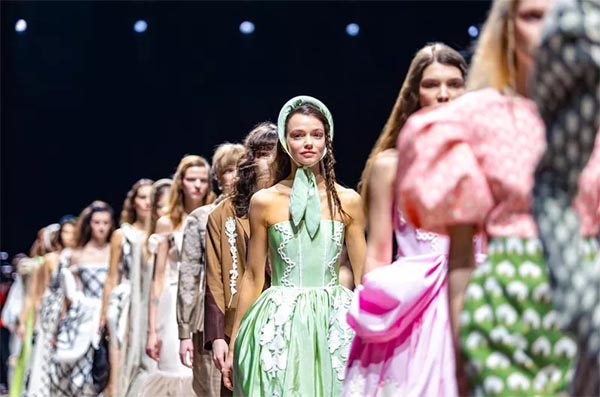
The intersection of fashion and beauty remains a powerful driver of trends. At Moscow Fashion Week (MFW) 2026 (held March 14-21), the beauty looks were distinctly “anti-effortless” in their complexity. The standout trend was “Cloud Skin,” a reaction against heavy contouring, favoring a fresh, breathable, natural glow that allowed the structural garments of designers like Ianis Chamalidy to shine.
Nail art also pivoted toward minimalism. “Barely-there nails”—milky nudes, beiges, and sheer finishes—dominated the runways, moving away from the extravagant 3D art of previous seasons. In hair, the look was “editorial sculpting”: controlled buns and sleek updos deliberately paired with loose, soft strands, balancing structure with intimacy.
Looking Ahead: The View to 2030
As Russia looks toward 2030, the roadmap is clear. The “Cosmetics in Russia” conference, held during InterCHARM, outlined a strategy focused on raw material independence. The national project “New Materials and Chemistry” aims to develop domestic active ingredients and biotechnological solutions, reducing reliance on imported European products.
For international brands looking in, the message from the 2025-2026 event circuit is clear: Russia is no longer a satellite of Western beauty standards but a distinct, massive market hub in its own right. Success here now requires partnership with local contract manufacturers, an understanding of Eurasian digital retail (Wildberries, Ozon), and a respect for the diverse natural resources spanning from Kaliningrad to Vladivostok.
The business of beauty in Russia has become a fascinating case study of adaptation. It is an industry that, faced with isolation, chose to look inward and eastward—and found a vast, lucrative, and uniquely beautiful identity waiting there.