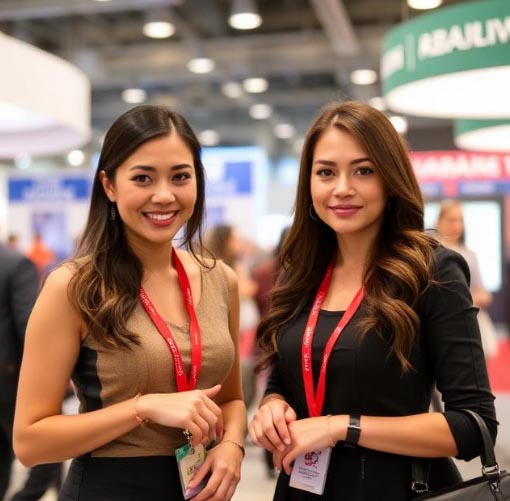
MOSCOW – Beneath the soaring ceilings of Crocus Expo International Exhibition Center, the sound of business is rarely in just one language. As one of Russia’s premier venues for international trade, Crocus Expo hosts hundreds of exhibitions and trade shows annually. While exhibitors showcase cutting-edge machinery, logistics solutions, and consumer goods, a specialized group of professionals works diligently in the background: the Russian-English interpreters.
In the fast-paced, high-stakes environment of a trade show floor, these linguists are far more than translators. They are cultural diplomats, technical experts, and the unseen engines of cross-border commerce.
The Nerve Center of International Commerce
Crocus Expo, located in Krasnogorsk, is a sprawling complex that draws thousands of international exhibitors and tens of thousands of visitors each year. It hosts major events such as TransRussia (logistics and rail transport), RosUpack (packaging), WasteTech (environmental technologies), AutoBusExpo (commercial vehicles), and IPSA Moscow (advertising and promotional products).
For a German machinery manufacturer or an American tech startup exhibiting at these events, the ability to communicate with Russian buyers, distributors, and government officials is not a luxury—it is a necessity.
“The role of the interpreter moves beyond mere linguistics,” explains a Moscow-based translation agency coordinator. “We are sending people into an environment where a single misunderstood number in a contract or a mistranslated technical specification could cost a company millions.”
More Than Words: Technical Expertise Required
The days when a general “language speaker” could suffice on a trade show floor are long gone. Today’s Crocus Expo interpreters often possess specialized industry knowledge.
Consider the WasteTech exhibition, which focuses on recycling and environmental technologies. An interpreter working a booth there must be fluent not only in English and Russian but also in the nuanced vocabulary of “waste-to-energy” conversion, circular economies, and advanced sorting machinery.
Similarly, at AutoBusExpo, where Chinese electric bus manufacturers meet Russian buyers, interpreters must know the difference between various battery chemistries and understand EAC customs union technical specifications. At the Rosplast plastics industry show, the jargon shifts to injection molding machines, extruders, and polymer composites.
The Daily Reality of Consecutive Interpretation
Unlike political summits that use soundproof booths for simultaneous interpretation, trade shows at Crocus Expo typically rely on consecutive interpretation. The interpreter stands beside a sales manager at a booth or across a negotiation table.
The process is grueling. The interpreter listens to a sentence or a pitch in English, memorizes it, and then reproduces it accurately in Russian—or vice versa. This requires immense concentration, a near-photographic short-term memory, and the stamina to stand for eight to ten hours a day.
“It is physically and mentally draining,” says Olga Minakova, an interpreter who has worked at the Necropolis exhibition at Crocus Expo. “You are not just processing words; you are processing tone, intent, and cultural subtext. You feel responsible for every deal that happens in your presence”.
Navigating Cultural Etiquette
One of the most critical, yet invisible, services these interpreters provide is navigating cultural nuance.
Russian business culture can be perceived as formal and hierarchical. A direct “no” or an overly aggressive sales pitch in English might damage a relationship, whereas a Russian response that sounds blunt to Western ears might be perfectly polite in context.
As noted in guides for events like IPSA Moscow, interpreters help bridge these gaps. They advise foreign clients on proper etiquette, such as the importance of punctuality, the formality of address (using first names versus patronymics), and how to exchange business cards correctly.
A Strategic Investment
For international companies looking to enter the Russian market or expand their footprint, hiring a professional interpreter for a Crocus Expo event is viewed as a strategic investment rather than an administrative cost.
“A professional interpreter ensures precision, saves time, and provides a competitive edge,” states a service provider for the WasteTech exhibition. “Companies with professional interpreters appear more credible and prepared to international clients”.
As Western sanctions evolve and Russia pivots its trade toward Asia, the Middle East, and domestic production, the role of the English language as a global lingua franca at Crocus Expo remains resilient. Whether it is a high-level logistics deal at TransRussia or a packaging supply contract at RosUpack, the interpreter remains the silent partner in every handshake.
Key Venue Facts:
- Location: Krasnogorsk, Moscow Region
- Major Events: TransRussia, RosUpack, WasteTech, AutoBusExpo, IPSA, Rosplast
- Services Required: Consecutive interpretation, technical terminology, cultural consulting
If you are exhibiting at Crocus Expo, industry experts recommend providing your interpreter with a briefing document containing key product terms and technical specifications well in advance of the show.
