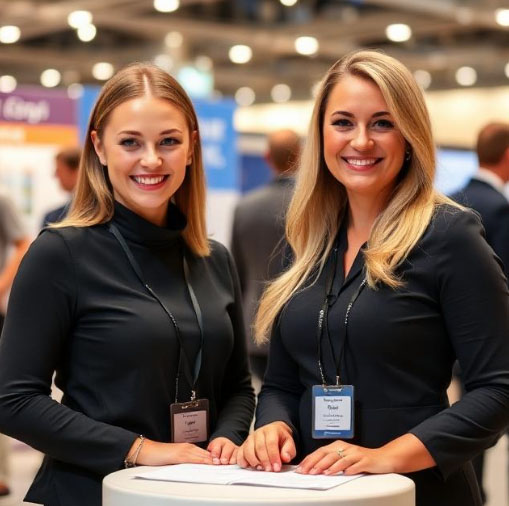
If walls could talk at Moscow’s Crocus Expo International Exhibition Center, they would speak dozens of languages.
Spanning over 400,000 square meters with 19 exhibition halls and 49 conference rooms, Crocus Expo is not just Russia’s largest exhibition center—it is one of the largest in the world. Every year, this sprawling complex in Krasnogorsk hosts over 350 events , from massive automotive trade fairs like COMvex and CTO Expo to specialized industry gatherings like MosBuild, Interlight, and the Moscow Boat Show.
But while the steel and glass provide the stage, the show cannot go on without the interpreters.
In the high-stakes world of B2B (Business-to-Business) events, the professional interpreter at Crocus Expo is far more than a dictionary on legs. They are deal-makers, technical consultants, and cultural diplomats rolled into one.
Here is why they are the unsung heroes of international trade at this iconic venue.
The “Mini-City” Challenge: Navigating the Scale of Crocus
To understand the interpreter’s job, you must first understand the venue. Crocus Expo is essentially a city dedicated to commerce. It features three major pavilions, a 6,200-seat music hall (Crocus City Hall), an on-site aquarium hotel, and a parking lot for 20,000 cars.
For an interpreter, this scale translates to logistical intensity. One morning, they might be interpreting a technical seminar in Pavilion 2 for the Interlight exhibition (smart homes and electrical engineering). By the afternoon, they are rushing via internal corridors to Pavilion 1 to facilitate a high-volume logistics deal at Logistika Expo.
The sheer diversity of industries present at Crocus Expo on any given day—ranging from animal feed at Agros to luxury yachts at the Moscow Boat Show—requires interpreters who are agile, fit, and mentally resilient.
Technical Precision: The Difference Between a “Deal” and a “Disaster”
Unlike a tourist guiding a sightseer, the B2B interpreter at Crocus Expo deals with life-or-death financial accuracy.
Consider the ComAutoTrans international exhibition (Commercial and Passenger Transport). A Chinese manufacturer discussing engine parameters, chassis technology, or electrical systems cannot rely on general vocabulary. A mistranslation of a torque specification or a delivery date could cost a factory millions of rubles.
Professional agencies supplying interpreters to Crocus Expo emphasize “industry experience.” For a fair like Interlakokraska (paints) or Analitika Expo (laboratory instruments), the interpreter must study technical glossaries weeks in advance. They must understand the chemical composition of a coating or the calibration of a spectrometer to ensure that the Russian buyer and the international seller see the exact same technical reality.
The Modes of the Trade Fair
Life at Crocus Expo is fast-paced, requiring interpreters to switch between different skill sets instantly:
- Simultaneous (The Conference): In the 49 meeting rooms and large auditoriums—such as the VIP suites or the main halls—interpreters work in soundproof booths. As a panel discusses the future of Russian-Chinese cooperation in logistics, the interpreter whispers the translation into headsets, allowing the conference to flow without pausing.
- Consecutive (The Booth Negotiation): This is the heart of B2B. An interpreter stands between a Russian logistics director and a European supplier. The speaker delivers two minutes of aggressive negotiation, stops, and the interpreter renders it. This allows for nuance, clarification, and the “reading of the room” that machines cannot replicate.
The Cultural “Booth Assistant”
At venues like Crocus Expo, the interpreter often doubles as a hostess or booth assistant. But their role goes deeper than pouring coffee.
Russian business culture can be hierarchical and requires specific etiquette. A foreign exhibitor might not realize they are being too casual with a senior Russian executive. A skilled interpreter will adjust the tone, manage the turn-taking in the conversation, and ensure that no cultural faux pas derails the negotiation.
As one report noted regarding the FlowersExpo at Crocus Expo, “Chinese and Russian business habits differ. The interpreter adjusts the expression appropriately to avoid misunderstandings and enhance trust”. This cultural gatekeeping is invaluable.
Why AI Cannot Replace the Crocus Expo Interpreter
With the rise of AI translation apps, some might ask if human interpreters are still necessary. At a trade fair like Crocus Expo, the answer is a resounding yes.
AI cannot handle the noise of a crowded exhibition hall. AI cannot read the sarcasm in a negotiation or the hesitation in a voice. Most importantly, AI struggles with the security and confidentiality required at high-level B2B events. When contracts are being signed and intellectual property discussed, businesses trust a human NDAsigner, not a cloud-based algorithm.
Conclusion: Booking the Voice of Your Business
Crocus Expo provides the infrastructure—the Myakinino metro station, the 20-ton floor load capacity, and the global foot traffic. But the interpreter provides the voice.
As Russia continues to pivot toward Eastern markets and deepen its internal industrial base, the demand for specialized interpreters at events like MosBuild and CTO Expo is soaring. These professionals ensure that the handshake at the end of the meeting represents a shared understanding, not a shared confusion.
If you are exhibiting at Crocus Expo, do not wait until you arrive in Moscow. Top interpreters specializing in your niche—whether automotive, agriculture, or IT—are booked months in advance. Secure your linguistic partner early. In the vast halls of Crocus Expo, silence is not golden—it is expensive.