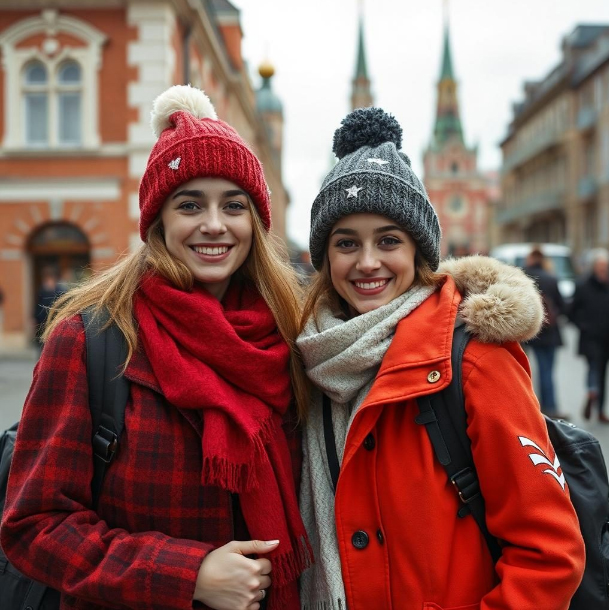
Russia in winter is not a single destination but a spectrum of experiences, ranging from the glittering imperial capitals of Moscow and St. Petersburg to the wild, frozen expanses of Lake Baikal and the aurora-lit skies of the Arctic Circle. It is a season that demands preparation and resilience, but for those willing to embrace the cold, it offers a version of Russia that feels almost mythic—a landscape of onion domes capped with snow, steaming bowls of borscht, and the profound silence of a frozen lake stretching to the horizon.
The Imperial Winter: Moscow and St. Petersburg
For most first-time visitors, winter in Russia begins in Moscow. Red Square in the cold months is a study in contrasts: Lenin’s tomb and the Kremlin walls stand in somber grandeur on one side, while the ornate facade of GUM department store glows with festive lights on the other. The city’s Christmas markets linger into January, with stalls selling matryoshka dolls and hot tea, and a carousel spinning for children who seem utterly unbothered by the sub-freezing temperatures.
No winter visit to Moscow is complete without an evening at the Bolshoi Theatre. A performance of a classic ballet like Sleeping Beauty offers pure sensory overload—the golden balconies, the burgundy walls, and the focused intensity of the dancers create a warmth that has nothing to do with the heating. Afterward, a meal of hot borscht (the earthy beet soup that many foreigners mistakenly believe is only served cold) and cherry-filled vareniki dumplings, perhaps with a shot of vodka, is the quintessential Russian winter experience.
A short overnight train ride—the famous Red Arrow—connects Moscow to St. Petersburg, where the Winter Palace and the Hermitage Museum offer endless indoor refuge from the cold. The city’s European architecture takes on a particular melancholy beauty under gray winter skies, and the frozen canals create a stillness that is impossible to find in summer.
Beyond the Capitals: The Wild Russian Winter
For those with more time and a taste for adventure, Russia’s winter landscapes extend far beyond the cities. Lake Baikal, the world’s deepest lake, transforms in February and March into a realm of transparent ice so clear that you can see stones and air bubbles frozen meters below the surface. Official ice crossings open only after the ice thickness has been verified, and visitors can walk, skate, or travel by hovercraft across the frozen expanse. The village of Listvyanka, about 70 kilometers from Irkutsk, serves as the most convenient base for ice tours.
In the far north, the Khibiny Mountains of the Murmansk region offer one of the most reliable chances to witness the Northern Lights. Late autumn and winter provide the clearest nights and the best conditions for the aurora to paint the dark sky in shifting curtains of color. For a different kind of winter wonder, the Kizhi Pogost or the wooden churches of the Russian North stand as testaments to centuries of survival in harsh conditions.
The Practicalities: What to Wear and How to Prepare
Russian winter is not to be underestimated. Temperatures can plunge to minus 20°C or lower, and the cold is a physical presence that shapes every decision you make. The key is layering: a thermal base layer, fleece or wool mid-layers, and a windproof, waterproof outer coat. Waterproof snow boots with serious grip are essential, as are fleece-lined hats, scarves, and gloves.
Indoor heating in Russia is famously powerful, so dressing in easily removable layers is crucial for moving between the frigid streets and overheated museums or cafes. A large thermos for hot tea or water is a small comfort that makes a disproportionate difference. Electronic devices suffer in the cold, so keeping a heat pack near your phone or camera battery is a practical trick.
One of the pleasant surprises of a Russian winter is how normal life continues despite the cold. Trains run on time, cafes stay busy, and people go about their days as if minus 30°C is simply another Tuesday. The Metro in Moscow and St. Petersburg becomes not just a transport system but a warm underground refuge, and the ornate stations—with their chandeliers, mosaics, and marble—are attractions in their own right.
A Word of Caution
Travelers should be aware that Russia currently presents a complex security and legal environment for foreign visitors. Government travel advisories from multiple countries note risks including arbitrary detention of Western citizens, restrictions on telecommunications and mobile internet for foreign SIM cards, and broad laws regarding public speech. Medical facilities outside major cities may be below Western standards, and medical evacuation can be difficult and expensive. Travel insurance that explicitly covers Russia is strongly recommended, and travelers should register their presence with their home country’s embassy.
The Reward
Russia in winter is not an easy trip. It asks for preparation, flexibility, and a willingness to be uncomfortable for the sake of something extraordinary. But the rewards are profound: the hush of Red Square at dusk, the steam rising from a bowl of borscht in a warm cafe, the surreal transparency of Baikal’s ice, and the green fire of the aurora overhead. It is a winter that stays with you—not despite the cold, but because of it.